
Introduction: R&D labs, teaching benches, and aging-test stations use programmable DC power supplies to keep output repeatable, observable, and easy to integrate.
A bench supply becomes commercially useful when it helps the team repeat the same experiment, isolate a fault faster, and move the setup from manual adjustment to controlled output. That is why buyers comparing a high precision DC power supply usually care less about broad marketing language and more about whether the source supports the kind of work they actually run: classroom demonstrations, small prototype power-up, electronic component testing, or low-risk aging runs. In B2B search, terms like wholesale DC power supply, programmable power supply manufacturer, DC power supply supplier, and programmable power supply supplier describe buying intent, not a wholesale policy, MOQ promise, or delivery commitment by themselves.
Why R&D and Teaching Benches Depend on Repeatable DC Output
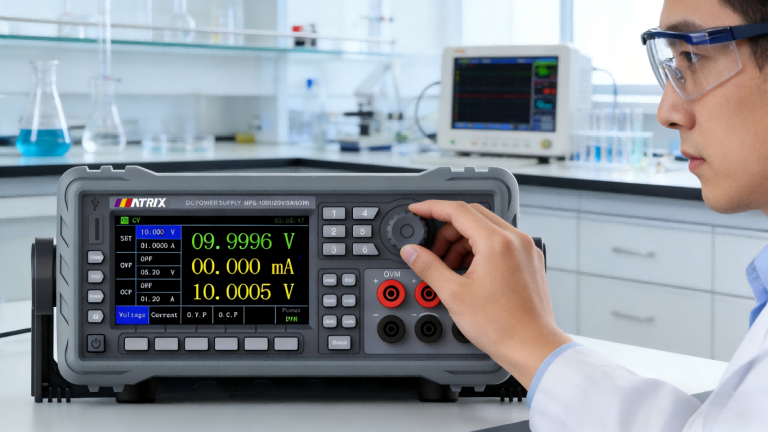
In early R&D, the point of a programmable DC power supply is not just to turn a device on. It is to make voltage and current changes predictable enough that a student, technician, or engineer can repeat the same test and compare the result without wondering whether the power source shifted between runs. That matters in electronics teaching as much as it does in prototype debugging, because a bench that can hold a set point, show the reading clearly, and respond in a controlled way makes it easier to connect theory to what the circuit is doing. MIT OpenCourseWare and similar training environments treat circuits and electronics as hands-on subjects for exactly that reason: the power source is part of the lesson, not just background equipment. For small projects, the decision is even more practical. A student board, sensor module, communication module, or maintenance task often needs a low-voltage source that can be adjusted in steps, observed directly, and changed without rebuilding the whole setup. That is where a programmable DC power supply is more useful than a fixed adapter or a battery pack, because the operator can see how the circuit reacts as conditions change and can return to the same setting later. SparkFun’s project-power guidance reflects the same basic problem from a learning and prototyping angle: the power source has to match the circuit, not just provide a nominal voltage. MATRIX Power Supply’s MPS-100 Series sits in this middle ground as a product example. MATRIX presents the series for R&D experiments, scientific teaching, electronic component testing, and maintenance-style work, which is the right wording for a laboratory DC power supply rather than a special-industry validation platform.
Which Functions Become Valuable When Tests Move into Component Aging
Once the work shifts from one-off demos to repeated component testing or aging tests, the useful features change. The best features are the ones that reduce setup drift, protect the device under test, and make repeated sequences practical without making the bench harder to run. Burn-in work is usually about exposing a component to controlled operating stress over time so weak points show up earlier, not about proving every failure mode can be eliminated. That is why function-to-application matching matters more than headline power claims, especially for laboratories and production-test teams that need repeatable steps rather than a broad claim of universal suitability.
- List sequence output matters when the test needs a repeatable voltage or current profile across multiple steps. In component aging, it can create a controlled ramp, dwell, or cycle pattern instead of asking an operator to turn the knob by hand at each stage, which reduces variation when several samples are compared.
- Parameter storage and recall matter when the same bench is used by different people or for different DUTs. The MPS-100 Series supports 9 groups of parameter memory, which helps keep lab setups consistent across classes, shifts, maintenance tasks, or repeated test runs without turning every restart into a manual reconstruction.
- OVP, OCP, and OTP matter because aging tests and component checks can fail in ordinary ways: a miswire, a short, a load spike, or an unexpected temperature rise. These protections do not guarantee a perfect outcome, but they help reduce the chance that one bad run becomes a larger equipment problem.
- RS-232, RS-485, SCPI, and MODBUS matter when the test bench is moving toward scripted control or automation. On the MPS-100C and MPS-101C, those connections are more relevant to production-test flow, logged steps, and automated stations than to a basic classroom demo.
This is also where buyer language should stay precise. A programmable power supply manufacturer may offer C models for integration, but that does not mean every model in the line is meant for the same control environment. The same is true for a DC power supply supplier: the right question is whether the power source matches the bench task, whether the sequence length and memory behavior fit the routine, and whether any communication requirement applies to that exact model rather than to the series name in general.
Where the Boundary Stops for Special-Industry and Higher-Power Work
The strongest use-case signal in the MPS-100 Series is its fit with laboratory and production-test work, not special-industry validation. That means the safe reading is narrow and useful: R&D experiments, teaching labs, component testing, aging tests, production testing, and automation line integration are within the current evidence set. Medical, vehicle, aerospace, military, outdoor, and storage-system work are not. Buyers should not default from a lab-friendly description to a compliance-ready assumption, especially when the series is rated at 150W or 180W and the available information does not establish those special-industry test boundaries. This is where search phrases need to be treated as search phrases. Wholesale DC power supply, programmable power supply manufacturer, DC power supply supplier, and programmable power supply supplier are useful for finding vendors, but they do not prove pricing structure, MOQ, stock policy, or shipping terms. They only show that the buyer is in a B2B sourcing mindset. If a project needs high-power industrial supply, regulated medical testing, vehicle qualification, outdoor exposure, or storage-system testing, the correct next step is to confirm the actual load profile, environmental conditions, documentation, safety requirements, and acceptance criteria before assigning the platform. A laboratory DC power supply can be the right tool for repeatable bench work while still being the wrong assumption for a regulated or harsh-environment program.
Conclusion
A programmable DC power supply is most valuable when the buyer needs repeatability, clear visibility, and controlled steps across teaching, R&D, and aging-test work. That is the level at which the MPS-100 Series makes sense as a MATRIX Power Supply example: it sits in the laboratory and production-test space, not in the default bucket for medical, automotive, aerospace, outdoor, or high-power industrial applications. For a B2B team comparing a programmable power supply manufacturer or DC power supply supplier, the practical decision is simple: match the source to the bench task, then confirm any special-industry requirement separately.
FAQ
Q:Where can a programmable DC power supply be used in a teaching lab?
A:It can be used at student benches, electronics demo stations, circuit-building exercises, and basic measurement labs where instructors need a repeatable source for voltage and current experiments. It is especially useful when the class needs to compare circuit behavior under different supply settings instead of relying on fixed adapters or batteries.
Q:How does List sequence output help in component testing or aging tests?
A:It lets the operator run a planned sequence of output steps so the DUT sees a controlled progression instead of manual adjustment. That is helpful in aging tests, because the same pattern can be repeated across samples, which makes comparison easier and reduces operator-to-operator variation.
Q:Should the MPS-100 Series be assumed suitable for high-power or medical testing?
A:No. The documented use cases support laboratory, teaching, component-test, and aging-test work, but they do not justify assuming suitability for high-power industrial supply, medical testing, vehicle qualification, aerospace work, or outdoor use. Those projects need separate confirmation of requirements, documentation, and environmental limits.
Sources / References
Circuits and Electronics | Electrical Engineering and Computer Science | MIT OpenCourseWare
How to Power a Project – SparkFun Learn
Burn-in Testing? – Accendo Reliability
Related Examples
MATRIX MPS-100 Series High-precision Programmable DC Linear Power Supply Product Details