

Programmable DC Supply Application Guide
The right power source is chosen by the workbench, not by the wattage on a brochure. This guide maps four everyday environments — R&D benches, production test racks, burn-in rooms and teaching laboratories — to the capabilities that decide whether an industrial programmable dc power supply protects your measurements or quietly disturbs them. We also look at how MATRIX TECHNOLOGY INC., one of a small group of programmable dc power supply manufacturers, engineers the MPS-100 Series so sequences repeat and the output stays quiet.
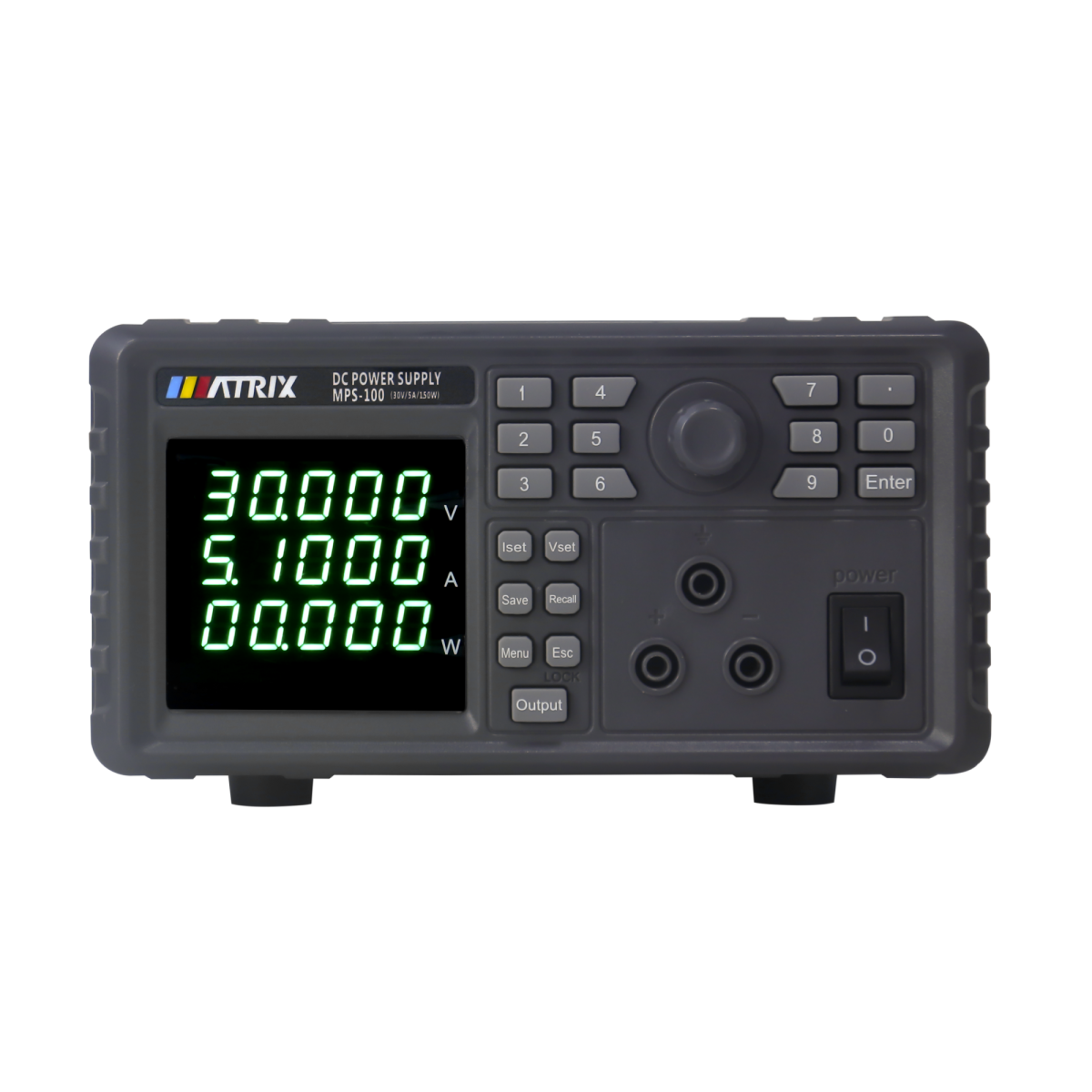
Four Scenarios, Four Different Failure Modes
The same supply can be ideal on one bench and wrong on the next. Before reading specifications, name what breaks in your environment — then check whether the series you are considering answers it.
R&D Lab Bench
What fails hereA prototype behaves differently on every power-up because the supply drifts between sessions and nobody re-types the same values exactly.
The capability that fixes itVery fine set and readback steps, plus stored parameter groups that restore a known setup in one action instead of a re-entry ritual.
MPS-100 Series — 9 memory groups
Production Line & ATE Rack
What fails hereAn operator keys in a voltage by hand, a wrong rail is applied, and a board that was never properly tested ships out.
The capability that fixes itCycling list sequences that run without an operator, a knob protected against accidental turns, and remote control so the rack, not the person, sets the rail.
MPS-100C / MPS-101C — RS-232 + RS-485
Aging & Burn-In
What fails hereA chamber runs for days, the rail creeps out of tolerance, or the unit shuts down partway through a run nobody is watching.
The capability that fixes itLong cycle counts that hold a pattern unattended, triple protection that trips on a fault instead of damaging the load, and fan speed that follows the load instead of running flat out.
MPS-100 / MPS-101 — 0–9999 cycles
Scientific Teaching
What fails hereStudents misread a single-line display, or a stray hand on the knob changes the experiment halfway through the lesson.
The capability that fixes itFive LED windows showing voltage, current and power at the same time, direct numeric entry for exact values, and knob protection that resists accidental adjustment.
MPS-100 Series — five LED windows
Failure Mode to Required Capability
Read the symptom in the first column, then specify against the capability in the second. The third column names the model or option that carries it.
| Symptom you are seeing | Capability required | Series or option to specify |
|---|---|---|
| Tests do not repeat between operators or shifts | Stored parameter groups plus exact numeric entry, so a setup is recalled rather than retyped | MPS-100 Series — 9 groups of common parameter storage/recall; 1 mV / 0.1 mA resolution |
| Supply noise is hiding small changes in the measurement | A linear output stage with low ripple and noise in both voltage and current | MPS-100 Series — <5 mVrms voltage, <3 mArms current ripple and noise |
| Unattended burn-in drifts or stops before the run ends | Cycle-based list output plus over-voltage, over-current and over-temperature protection | MPS-100 / MPS-101 — up to 10 steps, 0–9999 cycles; OVP, OCP, OTP |
| Hand-entered voltages differ from the released test plan | Direct numeric keypad entry with a knob that resists accidental movement | MPS-100 Series — numeric keys plus encoder with anti-misadjustment protection |
| The rack cannot log data or drive the supply remotely | Industrial interfaces and protocols supported natively rather than through adapters | C models — RS-232 + RS-485 with SCPI and MODBUS |
| The rail you need sits above the 30 V model’s range | A second power specification within the same family and control layout | MPS-101 (60V/3A, 180W) versus MPS-100 (30V/5A, 150W) |
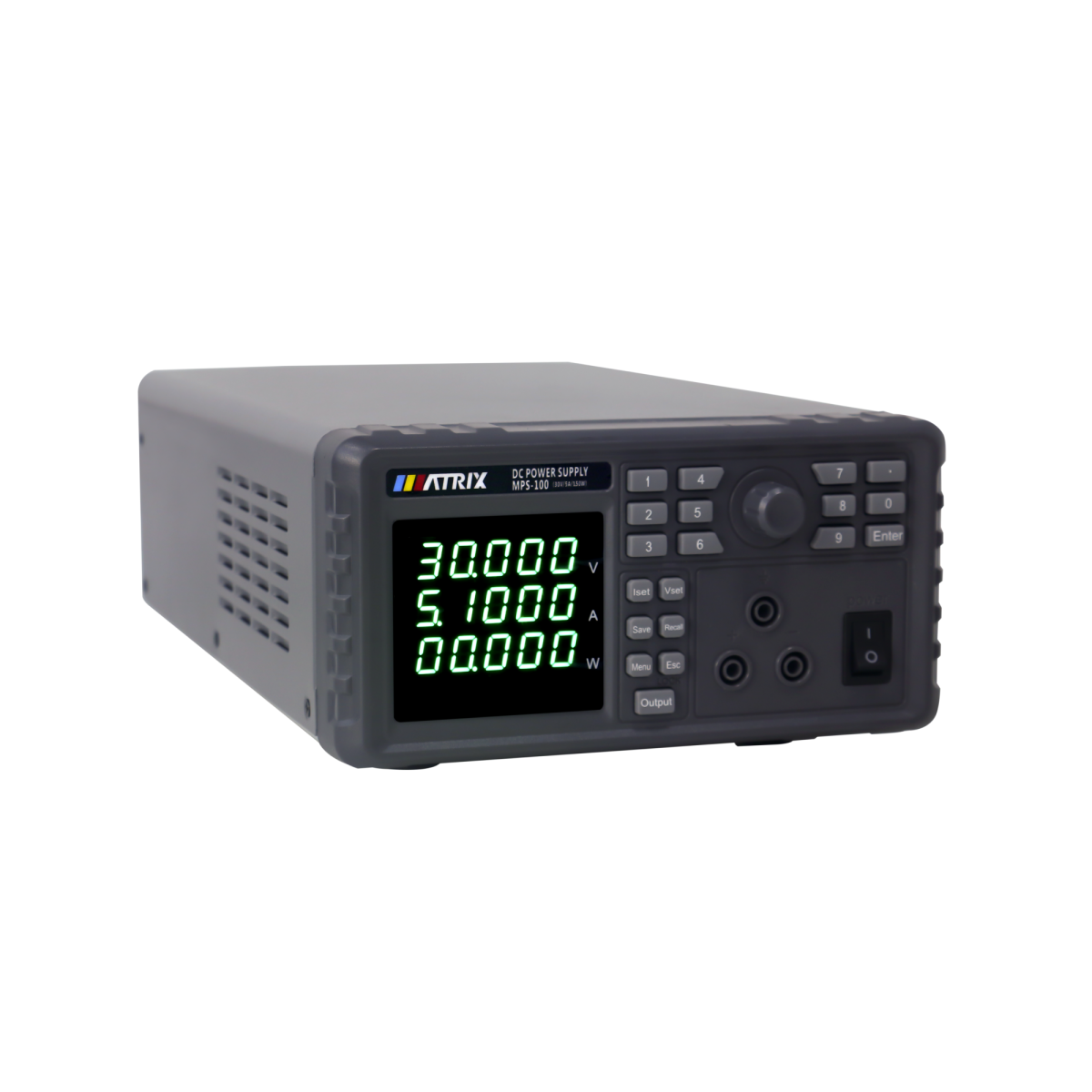
Front panel of the MPS-100 Series: numeric keys and encoder for precise entry, LED windows for live voltage, current and power readout.
Deep Dive: Repeatable Sequences with List Output
Repeatability is rarely lost inside the instrument. It is lost in the moment someone decides to change a value by hand. The List output function moves the whole pattern into stored memory, so the sequence is typed once and then merely started.
- Up to 10 steps per sequenceBuild the voltage and current pattern you need across up to ten ordered steps, then trigger it from the front panel.
- 0 to 9999 cyclesRepeat the pattern for a fixed number of loops — long enough to cover a burn-in run or a full batch without an operator standing at the bench.
- 9 groups of stored parametersRecall the setups you use most, so a shift change does not mean re-keying the test condition.
- Numeric keys plus encoder knobEnter exact values directly, or nudge the output with the knob when you are hunting a threshold.
- Anti-misadjustment knob protectionAn accidental turn does not silently move a running set point — important when the supply is left running.
- Voltage range settingKeeps the adjustment window aligned with the rail under test rather than the full output span.
What a Stored Sequence Looks Like
- Step 1
- Step 2
- Step 3
- Step 4
- Step 5
- Step 6
- Step 7
- Step 8
- Step 9
- Step 10
Each step holds the values you key in; the loop counter repeats the whole block up to 9999 times.
Deep Dive: Measurement Integrity on a Low-Noise Linear Output
A supply does not have to fail to ruin a test result. It only has to add something to the signal that was not there before. The MPS-100 Series uses a pure linear DC regulated topology, and the published figures are the ones to check against your measurement floor.
- 1 mV voltage resolution, 0.1 mA current resolutionSet and read back changes far finer than most benches need — useful when you are characterising a low-power device.
- <5 mVrms voltage ripple and noiseThe number that decides whether the supply can sit in front of a sensitive analogue or RF stage.
- <3 mArms current ripple and noiseMatters when leakage or quiescent current is part of what you are measuring.
- Five high-precision LED display windowsVoltage, current and power are visible together and in real time, so you are not toggling menus mid-measurement.
- OVP, OCP and OTP protectionA wrong rail, an over-current event or an over-temperature condition trips the supply rather than the device under test.
- Intelligent temperature-controlled fanSpeed follows the actual load, which keeps operating noise down during long, quiet bench sessions.
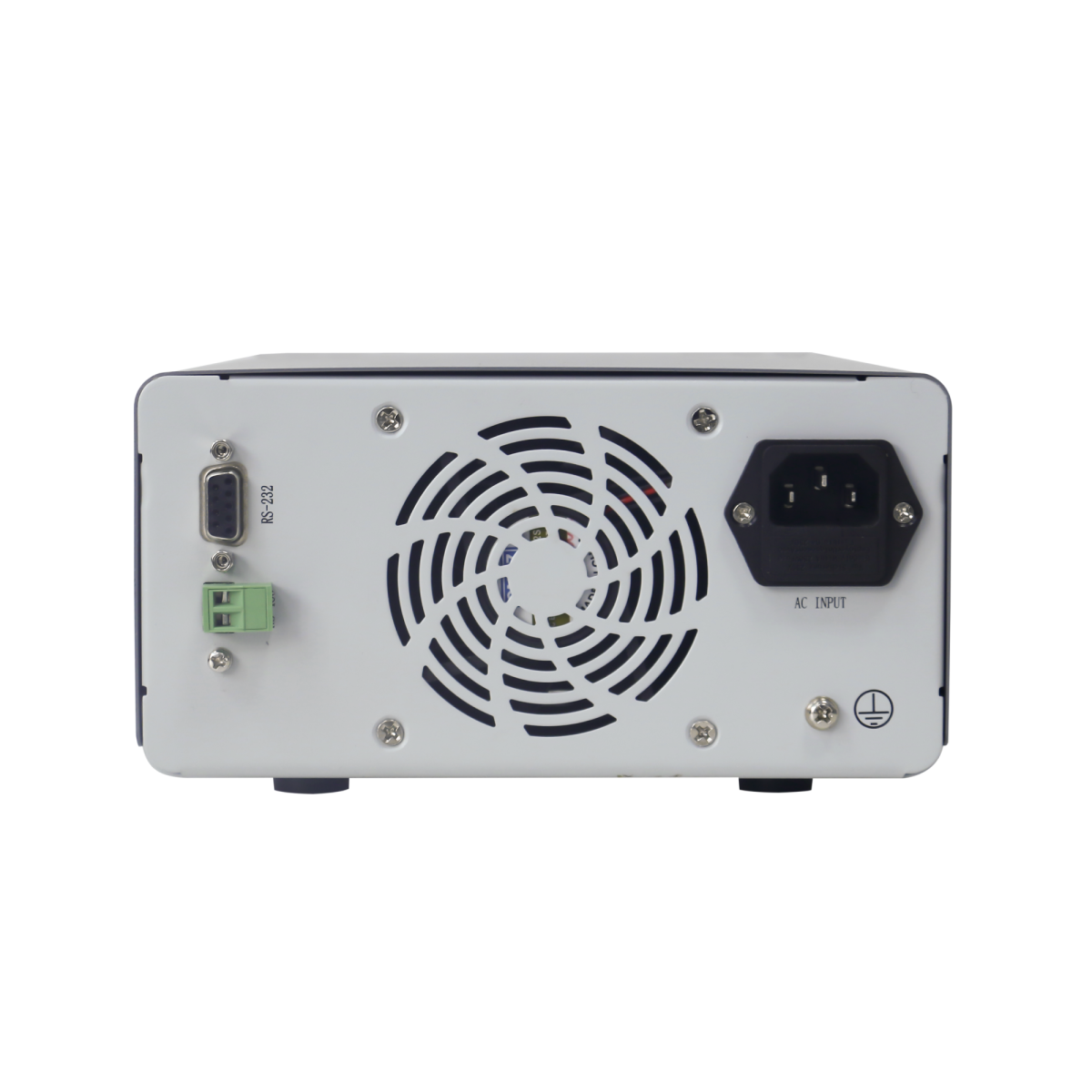
Five LED windows show voltage, current and power simultaneously, with OVP, OCP and OTP protection behind the output terminals.
MPS-100 Series Specifications at a Glance
Everything below is the current published data for the series. Use it as the checklist you compare against your load requirement.
Compact and portable housing — 185 × 105 × 295 mm, 4.5 kg net.
| Item | MPS-100 Series |
|---|---|
| Models | MPS-100, MPS-100C, MPS-101, MPS-101C |
| Topology | Pure linear DC regulated power supply |
| Power specifications | 30V/5A (150W) and 60V/3A (180W) |
| Voltage resolution | 1 mV |
| Current resolution | 0.1 mA |
| Voltage ripple and noise | <5 mVrms |
| Current ripple and noise | <3 mArms |
| Display | Five groups of high-precision LED display windows (voltage, current, power) |
| List output | Up to 10 steps; 0–9999 cycles |
| Memory | 9 groups of common parameter storage/recall |
| Protection | OVP, OCP, OTP |
| Communication (C models) | RS-232 + RS-485; SCPI and MODBUS |
| Optional (basic models) | RS-232 interface and SENSE function |
| Cooling | Intelligent temperature-controlled fan |
| Rated input | AC220V±10% or 110V±10% |
| Dimensions | 185 × 105 × 295 mm |
| Net weight | 4.5 kg |
| Operating temperature | 0–40℃ |
| Humidity | ≤85% |
| Warranty | 3 years |
Match the model and option set to the scenario before you request pricing.
Scenario-to-Specification Decision Path
Work down this list top to bottom. Each row turns a scenario into the specification that actually constrains the choice, so the enquiry you send already contains the right requirements.
| Your scenario | Specify this | Why it decides the choice |
|---|---|---|
| Bench work on rails up to 30 V, drawing up to 5 A | MPS-100 or MPS-100C — 30V/5A, 150W | The 5 A ceiling covers higher-current logic and small motor loads |
| Rails up to 60 V at lower current | MPS-101 or MPS-101C — 60V/3A, 180W | Same family and control layout, higher voltage window |
| Automated rack, data logging, scripted control | A C model | RS-232 + RS-485 with SCPI and MODBUS are standard on C models |
| Long leads where voltage drop at the load matters | Basic model with the optional SENSE function | Remote sensing regulates at the load end rather than at the terminals |
| Repeated sequences across operators and shifts | Any model, using List output | Up to 10 steps, 0–9999 cycles and 9 stored parameter groups |
| Measurements that cannot tolerate added noise | MPS-100 Series linear output | <5 mVrms and <3 mArms ripple and noise, 1 mV / 0.1 mA resolution |
Request a Quote or a Custom Configuration
Ordering on this product runs through an enquiry, not a shopping cart — which is an advantage when the supply has to match a specific rack, rail set or interface. Send the requirements and the configuration comes back matched to them.
- Bring your rail, current and interface needsVoltage, current, channel count and whether you need RS-232/RS-485 remote control with SCPI or MODBUS.
- Ask about base-model optionsThe RS-232 interface and SENSE function can be specified on basic models where the C-model interface set is more than you need.
- Multi-unit benches and volume ordersDescribe the number of stations and the repeatability requirement so the enquiry is quoted as one configuration, not several.
- Service expectationsThe series carries a 3-year warranty, and support hours run Monday to Friday 08:00–20:00 and weekends 09:00–18:00.
Enquiry-based ordering lets the model, option set and interface be matched to the rack before purchase.
Related Products
Keep adjacent product options together for a faster catalog comparison.
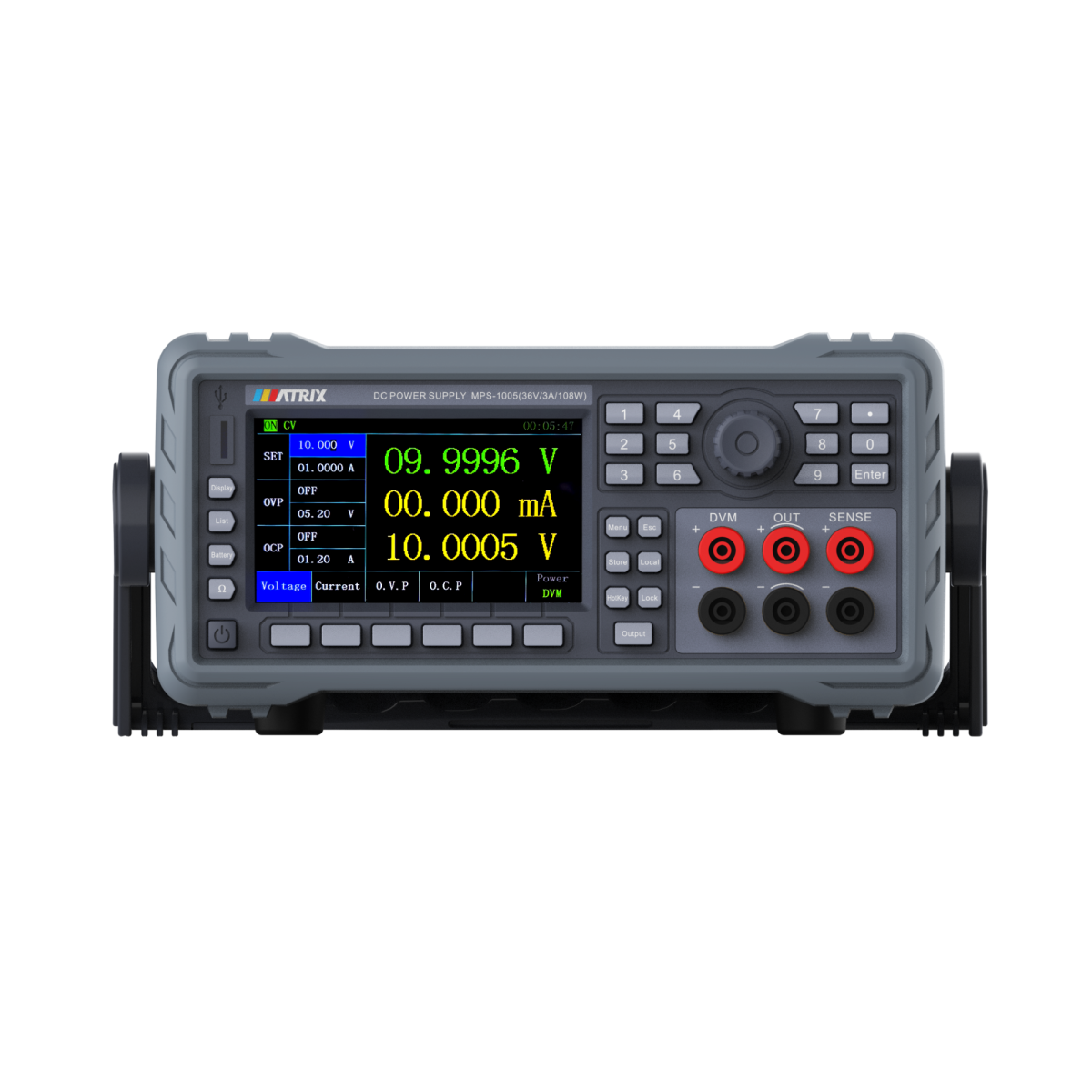
MPS-1000 Series High-Precision Programmable DC Power Supply
Single-channel linear supply (MPS-1001 to MPS-1012): 0-150 V, 0-10 A, 36 W to 360 W, 0.1 mV and 1 uA resolution, DVM, charging and waveform display.
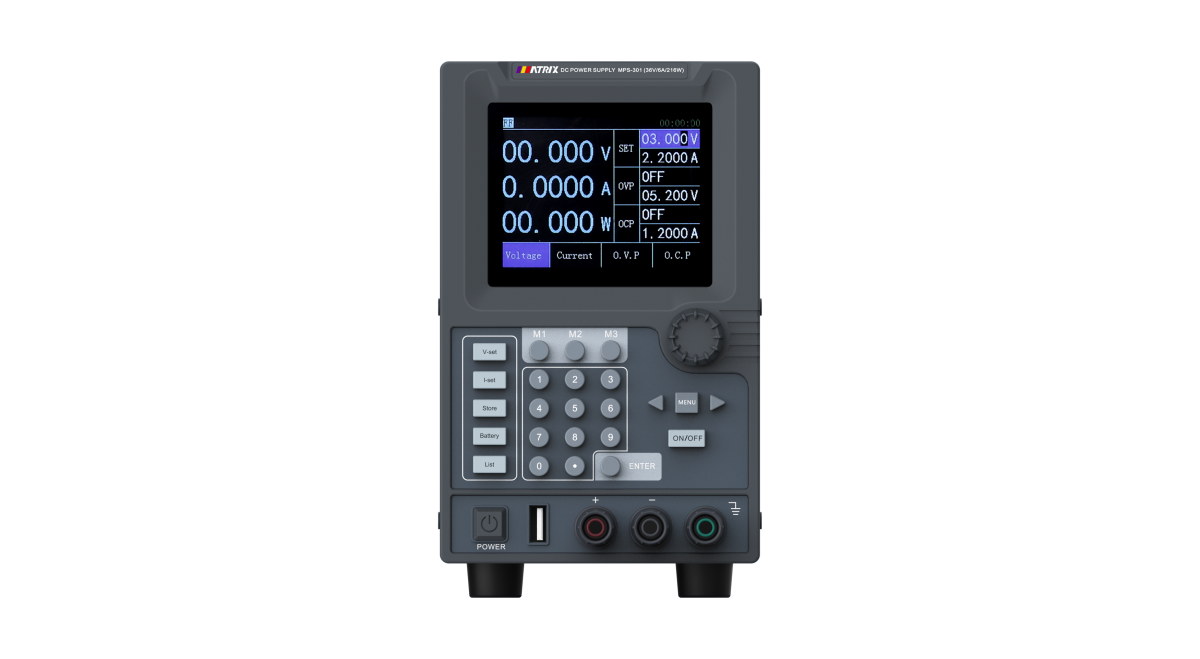
MPS-300 Series Single-Channel Programmable DC Power Supplies
Single-channel supply (MPS-301 to MPS-310): 0-160 V, 0-10 A, 100 W to 360 W, 1 mV and 0.1 mA resolution, charging and adjustable CC/CV priority.
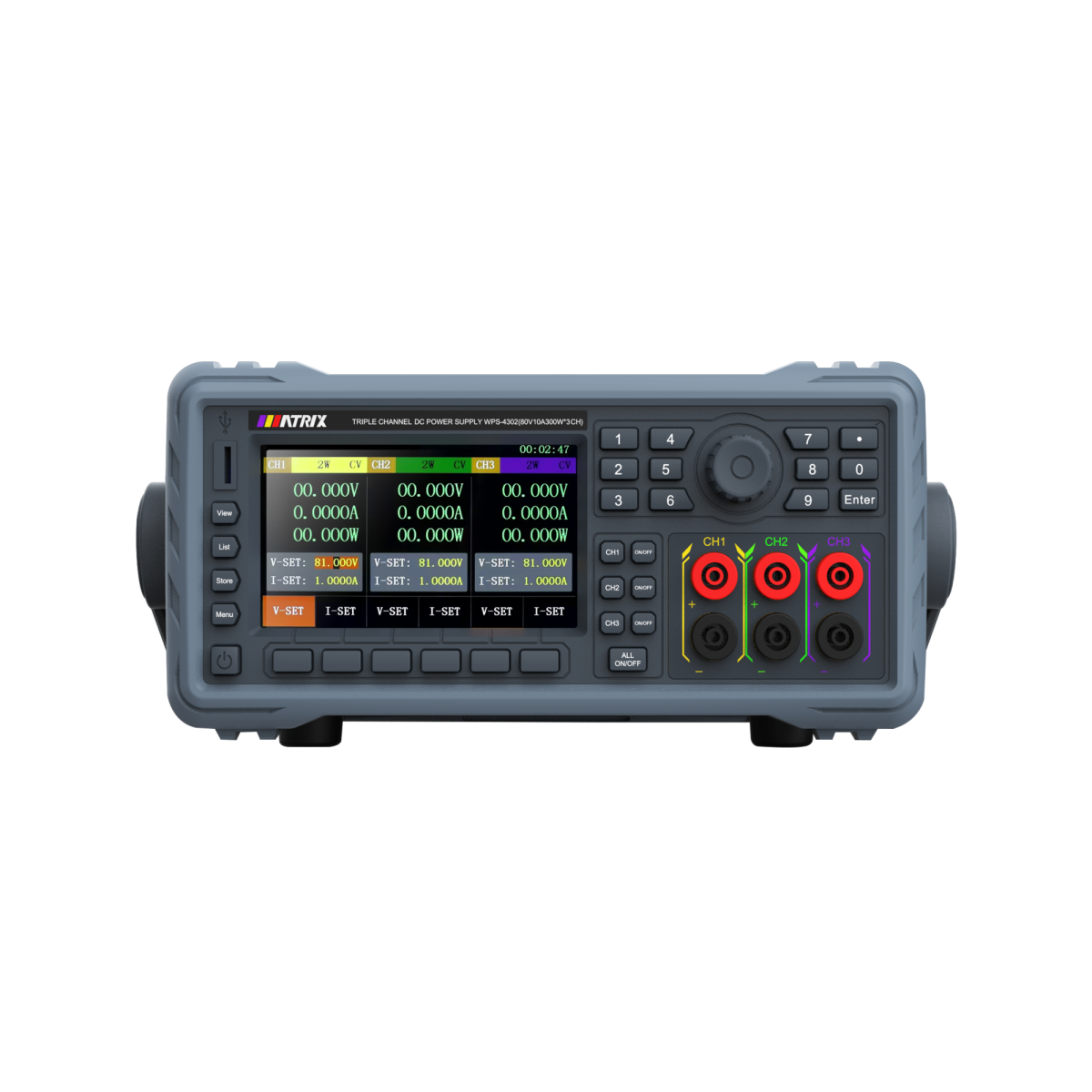
WPS-4300 Series 3-Channel DC Power Supplies
Three-channel supply (WPS-4301 to WPS-4303): 80/80/150 V at 6/10/5 A / 200/300/300 W, independent channel switching, List editing, RS-232/485/USB.
Frequently Asked Questions
Which models are in the MPS-100 Series?
four models: mps-100, mps-100c, mps-101 and mps-101c. they are built on two power specifications — 30v/5a (150w) and 60v/3a (180w) — and the c models come standard with rs-232 and rs-485 interfaces.
What resolution and noise performance does the series offer?
voltage resolution is 1 mv and current resolution is 0.1 ma. voltage ripple and noise is below 5 mvrms, and current ripple and noise is below 3 marms, from a pure linear dc regulated output stage.
How does the list output function work?
you build a sequence of up to 10 steps and run it for 0 to 9999 cycles, so repeated voltage and current patterns execute without an operator. nine groups of common parameters can be stored and recalled for the setups you use regularly.
Can the supply be controlled remotely or integrated into a rack?
yes. the c models include rs-232 and rs-485 connections and support scpi and modbus protocols for remote control, data acquisition and system integration. basic models can optionally be fitted with an rs-232 interface and a sense function.
What protection and thermal behaviour should I expect?
triple protection covers over-voltage (ovp), over-current (ocp) and over-temperature (otp). cooling is handled by an intelligent temperature-controlled fan that adjusts its speed according to the actual load, keeping operating noise low.
What is the warranty, and how do I request a quote?
the series carries a 3-year warranty. ordering runs through the enquiry form rather than a cart, so send your voltage, current, channel and interface requirements through contact us and the configuration and pricing come back matched to them.
